
What to expect after leaving the maternity hospital
The return of a baby and mother from the maternity hospital is the most anticipated moment in any family. Grandparents, siblings, everyone is equally excited to finally meet the new arrival. The return from the maternity hospital is both joyful and stressful, especially for first-time mothers and young parents who have many questions and uncertainties about the first steps of baby care. To give you an insight into what the first days with the baby are like, our physician Milivoj Jovančević, MD writes in his blog about what to expect after leaving the maternity hospital!
The baby is home, now what?
Upon arriving home from the maternity hospital, you need to notify the visiting nurse and schedule her visit. She will examine the newborn and provide detailed instructions on feeding and care. There will likely be several more visits, and if everything is fine, you should plan the first visit to the pediatrician when the baby is one month old. If the visiting nurse recommends an earlier check-up, make sure to do it without delay. Very often, in the first days at home, feeding problems arise, and mothers, out of fear that the baby is not getting enough food, start supplementing with formula. Do not make this decision on your own, as it is usually unnecessary and promptly contact your pediatrician who will help you maintain breastfeeding!
Preparing for the first pediatrician visit
Find out where the nearest pediatric office that accepts new patients is located as many offices are overbooked with more than the normative 1,000 children per team. Additionally, talk to other parents about their experiences and how satisfied they are with their pediatrician. Register your child as soon as possible (with the police, the Croatian Health Insurance Fund) – certainly before the first check-up.
Schedule the check-up in advance because most offices have specific times for seeing healthy children to avoid mixing sick and healthy children. Prepare all medical documentation from pregnancy and the discharge letter from the maternity hospital. You probably have many questions for the pediatrician, but it often happens that parents forget some of them during the check-up; therefore, write down your questions on a piece of paper and bring it with you.
Bring a spare disposable diaper and one cloth diaper on which you will lay the baby during measurement and examination. The pediatrician will ask if there have been any diseases in your family (epilepsy, febrile convulsions, congenital hip dislocation, amblyopia, diabetes in younger family members, colon polyps, etc.), and you should try to recall if there have been any of these or other illnesses that occurred frequently in your family.
Try to organize the first visit to the pediatrician so that both parents can attend. Both will have a lot to do (transportation, carrying things, undressing, changing, and dressing the baby) and it is useful for both parents to hear the advice from the nurse and doctor as very important information can often be missed in the excitement.
What to expect from the check-up
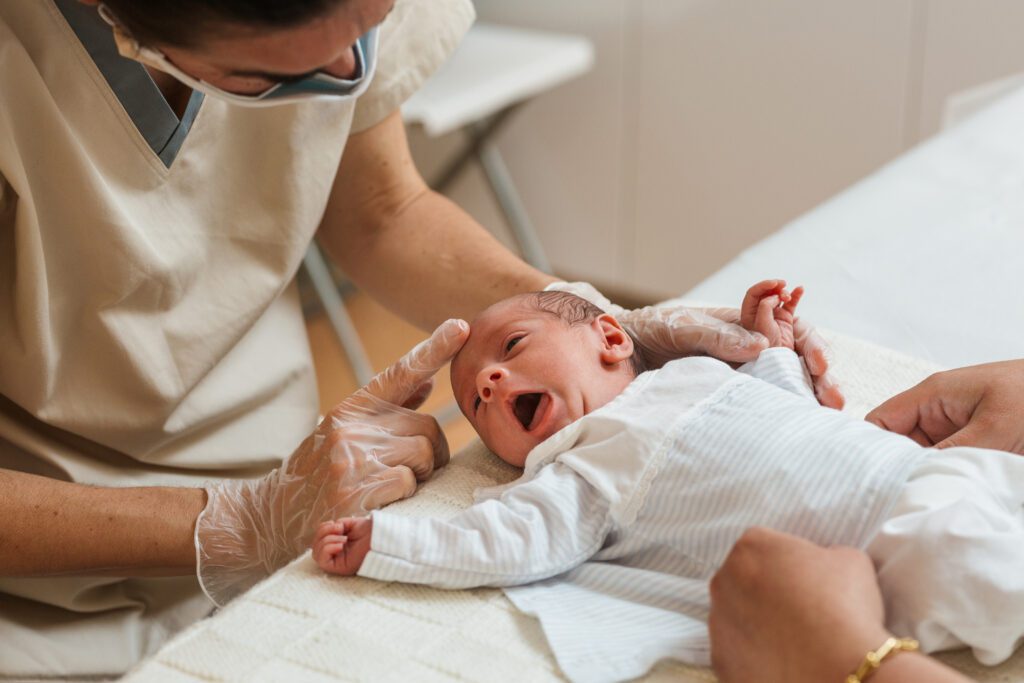
Upon arrival at the office, the nurse will open a personal health record and enter the parents’ and child’s information. It is useful to provide a phone number where the nurse or doctor can contact you if needed. Inform yourself about where and how you can seek help outside office hours in case of emergencies (evenings, nights, Saturdays, Sundays, and holidays). If the child stayed in the maternity hospital for a longer period or there were complications after birth, it is recommended to make a copy of the discharge letter to be kept in the health record. After that, the nurse will measure the baby’s weight, length and head circumference. Take the opportunity to ask the nurse about any concerns regarding the baby’s feeding and care.
The first check-up without tears and nervousness
Your newborn is very small and does not understand the anxiety and haste of the parents, which often arises during the first visit to the pediatrician. However, the baby very strongly senses these emotions and can also become anxious. Sometimes this anxiety can trigger stronger colic (cramps), so a baby that was usually calm at home may start crying inconsolably and painfully in the office. Try to be aware of your raised voice and fast speech, hurried movements, and, as much as possible, slow down and soften these activities.
It is generally best to schedule the check-up two hours after feeding – the baby is still satisfied, and the stomach is not too full of milk, which could cause more regurgitation (milk coming back from the stomach into the oesophagus and mouth) during crying and the examination.
If the baby becomes very upset during measuring and weighing (inconsolable crying), ask the nurse to place you in a quiet corner where you can feed and calm the baby.
Get to know your pediatrician
After talking with you, the pediatrician will perform a detailed examination and assess the child’s physical and psychomotor progress. This is an opportunity to get to know the pediatrician, to receive as much information and useful advice as possible and to ask all the questions you have about feeding, care, and the child’s overall health.
For a one-month-old baby, the pediatrician will recommend the start of rickets prevention with vitamin D drops (if vitamin K1 and D3 administration hasn’t already started from the 7th day of life in exclusively breastfed babies) and a preventive hip ultrasound.
According to the Health Care Plan and Program for children, check-ups are scheduled at 1, 2, 4, 6, 9, and 12 months of age in the first year of life.
When discussing the vaccination schedule, you will see that vaccinations are performed during planned systematic check-ups. The doctor may also request more frequent check-ups to monitor children with certain growth and development issues more closely. Talk about vaccinations and request additional information because the first vaccination will take place at the next visit.